Monstera
Devil
Devil is a distinctive Monstera known for its bold foliage, elongated lobes, and deep splits that create a sharp, dramatic appearance. Its unusual leaf form makes it an interesting choice for collectors who appreciate unique Monstera varieties.
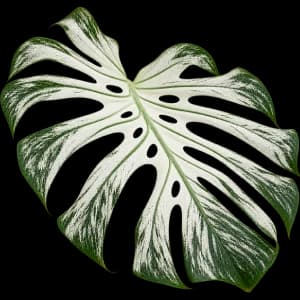
Monstera Devil Monster is a distinctive Monstera deliciosa known for combining unusual leaf morphology with highly variable variegation. Its foliage can display deep green, mint, cream, and white, appearing as large blocks, fine marbling, or dense speckling. Beyond color, the plant is also noted for leaves that can become wavy, distorted, or heavily textured, together with deep fenestrations that give the foliage a striking character.
What makes Devil Monster special?
The most fascinating feature of Devil Monster is that there is no fixed formula for every leaf. One leaf may be dominated by deep green with fine mint and cream details, while the next may develop much larger cream or white sections. Some plants show intricate marbling, feathering, or dense speckling across much of the leaf surface.
This variability is a major part of its appeal. Instead of expecting a specific pattern to repeat perfectly, growers often enjoy watching how each new growth cycle develops its own combination of color and form.
The distinctive leaf shape
Color is only part of what makes Devil Monster recognizable. Its leaf morphology is equally important. Some sources describe leaves that can become wavy, crinkled, or naturally distorted, creating a sculptural appearance rather than a completely flat leaf surface.
As the plant matures, its splits and fenestrations can become more pronounced. Deep veins and openings create a strong structural appearance, especially when combined with contrasting areas of green, mint, cream, and white.
The colors of Devil Monster
Devil Monster can display deep green, mint green, cream, and white variegation. These colors do not necessarily appear in a predictable pattern. Some leaves may have fine speckles, while others can develop marbling or large contrasting patches.
It is also important to remember that more white does not automatically mean a better plant. The green portions contain chlorophyll and perform most of the photosynthesis, so a healthy balance between functional green tissue and variegated tissue generally provides a stronger foundation for sustained growth.
Light for Monstera Devil Monster
Devil Monster prefers bright, indirect light. Sufficient light helps the green tissue maintain photosynthesis and supports healthy growth. A bright position near a window with filtered sunlight is often suitable.
Avoid prolonged exposure to intense direct sunlight. The lighter portions of the foliage can be more vulnerable to scorching, particularly when the plant has been growing in lower light. If you increase the light level, do so gradually to allow the plant to acclimate.
Soil and root health
A healthy Devil Monster needs a healthy root system to support continued foliage development. The growing medium should be airy, well-draining, and capable of retaining moderate moisture. A chunky aroid-style mix containing materials such as bark and perlite can create useful air spaces around the roots.
Avoid allowing the substrate to become compacted or remain saturated for long periods. Roots need both water and oxygen, and prolonged lack of oxygen can interfere with healthy growth.
Watering Devil Monster
Devil Monster should not be watered according to a rigid schedule. Check the growing medium and water once the upper layer has dried noticeably. When watering, thoroughly moisten the root zone and allow excess water to drain completely. Some commercial care guides recommend watering when approximately the top two inches of substrate have dried.
The goal is to avoid keeping the plant continuously wet while also preventing the entire root zone from remaining completely dry for extended periods. A consistent wet-and-dry cycle based on the actual conditions of the pot is more useful than watering on a particular day.
Humidity and environment
Devil Monster grows well in a warm environment with relatively high humidity. Some care sources recommend around 60–80% humidity, while commercial growing conditions may vary depending on the environment.
Higher humidity should still be accompanied by good airflow. Stagnant air combined with overly wet substrate can increase the risk of root and foliage problems. Indoors, keep the plant away from strong cold air-conditioning drafts and direct heat sources.
Helping Devil Monster develop larger leaves
Devil Monster has a climbing growth habit, so providing a moss pole or sturdy support can make a noticeable difference as the plant matures. With support, the vine can grow upward and develop larger foliage with more pronounced fenestrations.
There is no need to focus solely on growth speed. With a highly variegated plant, growth can naturally vary from one cycle to another. A stable plant with healthy roots is more important than forcing rapid new growth.
Keeping the leaves beautiful
The unusual leaf structure of Devil Monster becomes even more impressive when the foliage is clean. A soft, slightly damp cloth can be used to gently remove dust while allowing you to inspect the undersides of the leaves and petioles for pests.
Avoid rubbing the lighter variegated areas aggressively. Cream and white tissue can show marks easily if the surface is scratched or physically damaged.
Will the pattern stay the same?
This is one of the most interesting aspects of Devil Monster: there is no guarantee that the next leaf will resemble the current one. Growing and retail sources consistently emphasize the variability of its variegation from leaf to leaf. One growth cycle may produce fine speckling, the next may show much more cream or white, while another leaf may be predominantly green.
For that reason, it is better to evaluate a Devil Monster by looking at several leaves and the active growth point rather than choosing the plant based only on its whitest leaf. A healthy plant with interesting, sustainable variegation across multiple growth cycles is more meaningful than one spectacular leaf.
When should you repot?
Devil Monster does not need frequent repotting. Consider repotting when the roots have developed substantially, the container has become crowded, or the growing medium has degraded. Some growers recommend waiting with young plants until a strong secondary root system has developed before moving them into a larger container.
The new container should only be moderately larger than the previous one. An oversized pot can retain too much moisture around the root system and make watering more difficult to control.
Devil Monster – every leaf is a surprise
What makes Devil Monster fascinating is not only its combination of green, mint, cream, and white, but also the interaction between its color and unusual leaf structure. One leaf may carry delicate speckles, another may develop bold marbling, while the leaf itself can add dramatic waves and deep fenestrations to the overall appearance.
This makes Devil Monster particularly appealing to collectors who enjoy plants that cannot be completely predicted. Bright indirect light, an airy growing medium, appropriate watering, stable humidity, and strong climbing support give the plant a good foundation for healthy development. And with Devil Monster, every new leaf has the potential to look completely different from the one before it.
Reviews
No reviews yet. Be the first to share your experience.