Monstera
Bulbasaur
Holes appear early on a slender vine: hang it or climb it, as long as humidity never turns into wet soil.
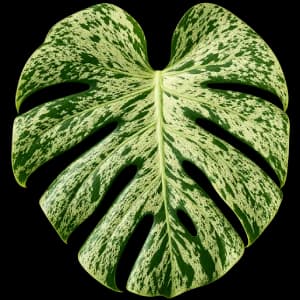
Monstera deliciosa ‘Bulbasaur’ is a distinctive variegated Monstera known for its unusual color pattern. Instead of producing large areas of white or smooth marble-like streaks, Bulbasaur often combines dark green, mint green, pale green and cream in irregular patches that resemble camouflage or pixel-like artwork. This distinctive pattern is also the inspiration behind its nickname, Bulbasaur.
What Makes Monstera Bulbasaur Special?
The most interesting feature of Bulbasaur is the way multiple shades of green interact across the same leaf. Dark green areas may sit beside mint or cream sections, creating relatively defined edges and irregular shapes. Some sources describe the pattern as pixelated or mosaic-like, while other growers and nurseries describe it as speckled or marbled mint variegation.
From a distance, Bulbasaur still looks like a familiar Monstera deliciosa. Up close, however, the numerous patches and color transitions give each leaf its own visual character.
The Leaves Can Change Over Time
One of the most exciting parts of growing Bulbasaur is that the next leaf cannot be predicted perfectly. The balance between dark green, mint and lighter areas can change from one leaf to another.
Bulbasaur plants currently entering commercial production also show differences in variegation intensity. Some plants display strong coloration, while others carry considerably more green. Growers have also reported changes in variegation from one growth cycle to another, so a single highly variegated leaf should not be treated as a guarantee for every future leaf.
This is particularly relevant to tissue-cultured plants. Bulbasaur TC plants are now increasingly available, but individual plants can still express their coloration differently as they acclimate and mature.
Mint Green Gives Bulbasaur Its Character
Unlike variegated forms that rely mainly on white or yellow, Bulbasaur stands out because of multiple shades of green appearing together on the same leaf. Dark green creates depth, while mint and pale green brighten the surface. Some plants also develop cream-colored areas that increase the contrast even further.
The darker green sections can also form relatively compact, clearly defined shapes instead of blending completely into the surrounding mint areas. This contributes to the distinctive “pixelated” appearance that experienced Monstera collectors often associate with Bulbasaur.
Mature Leaves Become Even More Impressive
Bulbasaur retains the general growth structure of Monstera deliciosa. Juvenile plants typically have simpler leaves with fewer splits, so they may not immediately reveal the full character of a mature plant. As the plant grows, the leaf blades become larger and develop the characteristic fenestrations associated with mature Monstera deliciosa.
This creates an interesting combination: Bulbasaur's unusual coloration develops across increasingly large Monstera leaves with more mature fenestration. A young plant may therefore look relatively simple at first and become much more impressive as it matures.
Light for Monstera Bulbasaur
Bulbasaur performs best in bright, indirect light. Good lighting supports healthy growth and helps the variegation remain visually strong. Costa Farms recommends placing the plant near an unobstructed east- or west-facing window; it can tolerate medium light, although growth may slow and the variegation may become less pronounced over time.
More light does not mean more intense direct sun. Lighter areas of the foliage can be more sensitive to harsh sunlight and may scorch. Bright, stable and filtered light is generally a better balance for maintaining both plant health and attractive foliage.
Soil and Root Health
A healthy Bulbasaur needs an oxygen-rich root environment to support continuous new growth. The growing medium should be airy and well draining, while still retaining a moderate amount of moisture.
An aroid-style mix containing bark, perlite, coco fiber and other airy materials can work well. More important than any single recipe is avoiding compacted soil and prolonged saturation. A healthy root system gives the plant a more stable foundation as it produces new leaves.
Watering
Bulbasaur does not need to be watered according to a fixed schedule. Check the growing medium first and wait until the upper portion has begun to dry before watering again.
When watering, soak the medium thoroughly and allow excess water to drain completely from the bottom of the pot. Keeping the roots constantly wet can reduce oxygen and increase the risk of root rot. Allowing the plant to become excessively dry, on the other hand, can reduce leaf firmness and slow growth.
Humidity and Environment
A warm environment with relatively stable humidity suits Bulbasaur well. Some growers recommend around 50–70% humidity, while tissue-cultured plants may be kept in higher-humidity environments during acclimation.
If the plant is grown in an air-conditioned room, avoid placing it directly in the path of cold airflow. Stable conditions are especially useful while the plant is actively producing and unfurling new leaves.
Keeping the Colors Looking Their Best
Bulbasaur looks most impressive when the foliage is clean and the different shades of green can be seen clearly. Gently wiping dust from the leaves and checking the undersides regularly can also help detect pests early.
With variegated plants, it is also useful to watch how new leaves develop over time. A greener leaf does not necessarily mean that the plant has permanently lost its variegation, just as one highly patterned leaf does not guarantee the same ratio on every future leaf. Grower reports on Bulbasaur show that expression can change between growth cycles.
Bulbasaur Is More Than Just Variegation
What makes Monstera Bulbasaur interesting is not simply that it has multiple colors, but the way those colors are arranged. Dark green, mint, pale green and occasional cream areas form irregular patches that look almost like camouflage painted across the leaf.
Costa Farms describes Bulbasaur as a naturally occurring sport of Monstera deliciosa and notes that it is often propagated through tissue culture to help preserve its distinctive variegation pattern.
And much like the name itself suggests, Bulbasaur has a playful quality that makes it stand out: each leaf feels like its own little color map, with green and mint patches that never look completely identical.
Reviews
No reviews yet. Be the first to share your experience.